Artificial intelligence has helped find molecules for the perfect blue color in OLED screens.
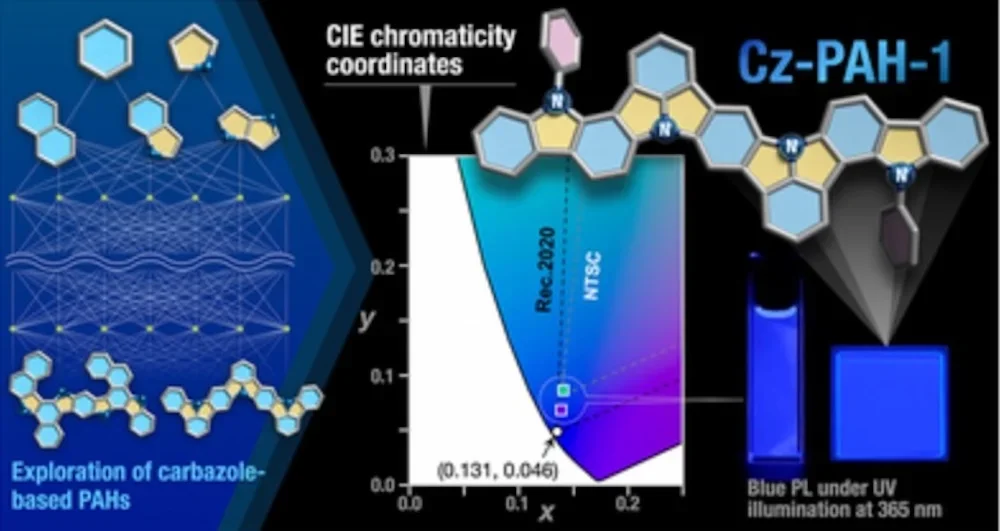
The problem is that blue is the most challenging color to create for organic LEDs. It must be bright, pure, and energy efficient. However, many existing blue materials contain boron, making their synthesis difficult and expensive. The search for efficient blue light emitters has long been a trial-and-error process.
The researchers proposed an approach that combined computer screening of nearly 20,000 hypothetical structures, quantum chemical calculations for the most promising variants, and training a neural network that predicted the molecules' properties. The artificial intelligence quickly selected the two most promising compounds, which were then synthesized in the lab and tested.
The resulting molecules exhibited a narrow blue emission with a peak width of just 17–19 nanometers, indicating high color purity, a small energy gap enabling efficient energy-to-light conversion, and high thermal stability, which is important for display manufacturing. OLED devices were assembled using these materials, one of which achieved color purity close to the Rec. 2020 reference standard used in ultra-high-definition televisions. In another configuration, the external quantum efficiency reached a record-breaking 35.2%—meaning more than a third of the electrical energy was converted into light.
The developed method allows for the search for new materials to be accelerated hundreds of times: instead of years of experimentation, scientists can first sift through thousands of options on a computer and then test only the most promising ones, paving the way for the creation of brighter, more durable, and energy-efficient screens for TVs, smartphones, and monitors.

Log in to like, dislike, or write your own post.
Comments 0
No comments yet
Log in to leave a comment.